Marine structures are not only critical for oil and gas exploration, they are growing in importance for the renewable energy sector. This includes floating solar schemes as well as offshore wind farms that can be sited well over 10 km from shore. Corrosion is a major issue for these structures as they are exposed to a chloride-rich environment, wet-dry cycles, high humidity, and microbiological attacks. They may also be subjected to abrasion and wear from sand, floating waste and currents. Material selection, together with the methods used to protect against corrosion protection, therefore plays an important role in determining the reliability, maintenance needs and lifetime of structures which are often expected to stay in service for 20 to 25 years or more.
raditionally, carbon steel has been protected against the corrosive marine environment by applying a coating. This adds to the initial fabrication cost, while a corrosion allowance is often added to the wall thickness, resulting in increased material costs. Furthermore, coated carbon steel structures typically require maintenance such as recoating, replacement of corroded steel plates and repair work during their service life. Switching to stainless steel, with its inherent corrosion resistance, offers the potential to reduce life cycle costs as well as the impact on health and safety and the environment.
Rather than the conventional 304L and 316L grades, using higher strength duplex stainless steel offers particular advantages for marine structures. This family of materials combines both austenitic and ferritic microstructures to offer the best properties of each main type of stainless steel: corrosion resistance and high strength. This allows the design of lighter structures based on thinner gauges.
In addition to saving weight and material cost, duplex grades offer further advantages such as extended fatigue life and high hardness that gives better resistance to wear and erosion. In addition, duplex grades contain a lower amount of nickel compared to both standard austenitic and high-performance austenitic stainless steel, which means they have less volatile pricing. The performance advantages of higher strength duplex grades are illustrated in Figure 1.
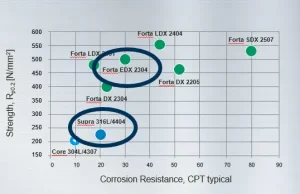
Figure 1 – Comparison of strength and corrosion resistance of stainless steel grades – the Forta grades are duplex stainless steels. CPT is the critical pitting temperature in degrees Celsius at which corrosion starts, it is a useful measure that helps design engineers compare the likely performance of different materials.
Since the corrosion resistance of duplex stainless steel doesn’t depend on an external coating, the risk of failures caused by possible damage to the coating can be avoided. This is important, especially in offshore structures where limited access makes inspections and repair work hard to carry out.
A cost-effective solution
Duplex stainless steel has a higher initial cost compared to carbon steel, so will not seem appealing to a designer that considers only the material price per tonne. However, that does not show the true story as using duplex grades will make a significant impact over the life of a structure through reduced weight, longer lifetime and less maintenance. This is illustrated in Figure 2.
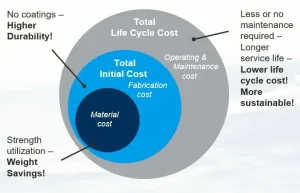
Figure 2 – It is important to compare duplex stainless steel and carbon steel on a total Life Cycle Cost (LCC) basis
It is important to make comparisons on a case-by-case basis. Even so, our experience is that the potential weight saving from switching to lean duplex stainless steel can offer savings of between 30 to 40%. That is before the LLC costs are taken into consideration.
Welding duplex stainless steels – not difficult, but different
The welding of duplex stainless steel is not particularly difficult. But it is different to other steels. In fact, the weldability and welding characteristics of duplex stainless steels are better than those of ferritic steels, although not generally as good as austenitic steels. The properties of a duplex weldment are strongly affected by the welding parameters such as heat input. Therefore, it is vital to establish the correct welding procedures to obtain a structure that delivers the required strength and corrosion-resistance.
Galvanic corrosion is not a major concern
There are concerns about galvanic corrosion when stainless steels are in contact with other metals such as carbon steel, galvanized steel, copper and brass. However, duplex stainless steel is not typically attacked in this way since it is usually the most noble material in the galvanic couple. Galvanic corrosion can usually be prevented with proper design and by electrically insulating dissimilar metals.
Different grades for different zones
Offshore structures can be exposed to different corrosion zones that require different material solutions and corrosion protection methods. These zones are defined in Figure 3.
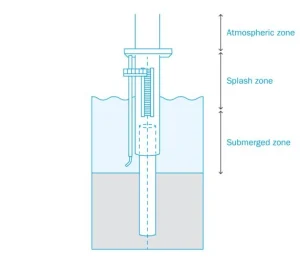
Figure 3 – Schematic representation of marine corrosion zones
Atmospheric zone
In the atmospheric zone, marine structures are exposed to airborne chlorides and therefore at risk of chloride-induced atmospheric corrosion. The marine atmosphere is a demanding environment in which factors such as atmospheric salt content, temperature, and relative humidity affect the corrosivity. These factors are mainly dependent on geographical location. Sheltered conditions where rainwater is not able to naturally clean the surfaces of the structures will lead to a more severe situation.
In the atmospheric zone, corrosion is commonly controlled by using corrosion-resistant alloys or protective coatings. A variety of stainless steels can be used in this zone depending on the corrosivity of the environment and the design of the structures. It is also important to note that the surface roughness of stainless steels can have a significant impact on their performance since a smoother surface typically offers higher corrosion resistance to atmospheric corrosion.
In less aggressive marine atmospheres, lean duplex stainless steels like Forta LDX 2101, Forta DX 2304 and Forta EDX 2304 may be the most cost-effective options. They can be expected to perform well if there is natural cleaning by rainwater and the design does not contain severe crevices. Otherwise, a higher corrosion-resistant duplex stainless steel like Forta DX 2205 may be better.
Splash zone
The splash zone is an extremely aggressive environment. Designing structures in this zone is recognized as a critical challenge. For carbon steel, the highest corrosion rates occur in this zone, but this is not necessarily the case for stainless steel.
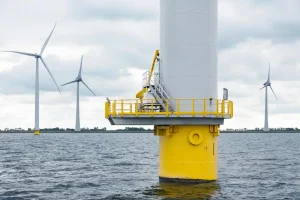
In the splash zone, the structures are exposed to wetting by oxygen-rich seawater, wet-dry cycles and UV radiation. The wet-dry cycles can increase chloride contents as the water evaporates, leading to highly severe conditions. Furthermore, structures may be subjected to erosion due to spray, waves and tidal actions, as well as mechanical stresses due to ice drifting, collisions, and floating debris.
Corrosion protection of carbon steel structures in the splash zone requires special consideration. The most common way to protect carbon steel against corrosion is to combine coating with a corrosion allowance. In cases where protective coatings are applied, the risk of mechanical damage, such as wear or scratching of the coating must be considered. Once the coating is damaged, a process of preferential corrosion in the exposed area of the base metal can be accelerated by the galvanic coupling formed. Cathodic protection is not reliable in the splash zone due to the lack of continuous contact with the electrolyte (seawater). In this zone, high-performance stainless steels are reliable alternatives to carbon steel. Depending on how aggressive the conditions are, Forta DX 2205 and Forta SDX 2507 may be options
(Excerpt from an interview with Outokumpu)